Gamdom Games: Slots, Originals, Live Casino and Providers
 Available in US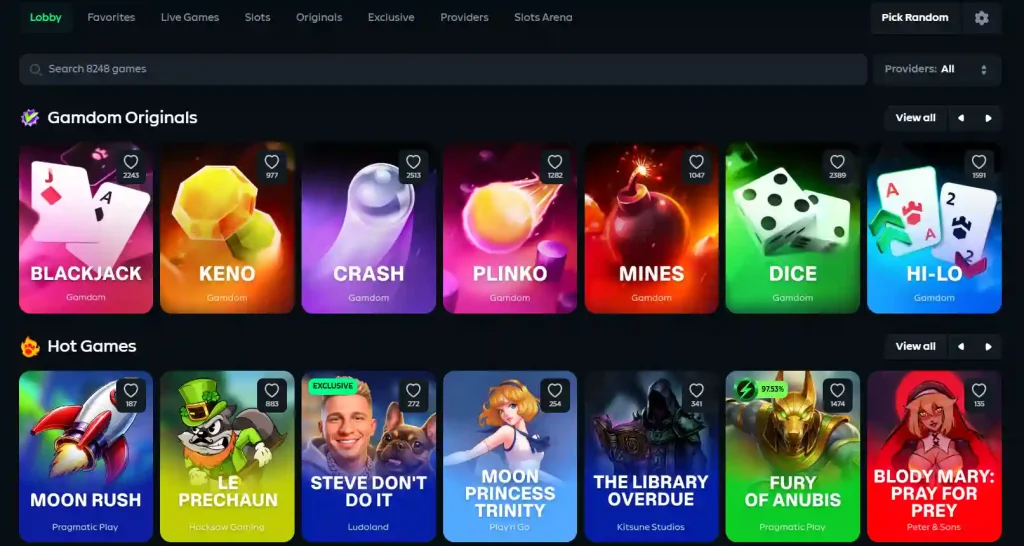
Gamdom Australia Guide
Updated 8 September 2026
Gamdom has a broad casino catalogue spanning slots, table games, live-dealer games and its own Gamdom Originals. Current first-party material places the library in the thousands and names more than 40 providers, with featured studios including Evolution Gaming, Pragmatic Play, Hacksaw Gaming, Betsoft and OneTouch. The in-house range includes Crash, Dice, Plinko, Mines, HiLo and Roulette, among other Originals.
The exact total game count is less stable than those category-level facts. Gamdom’s indexed casino page currently says 5,000+ titles, while an official Help Center overview has used 3,000+. Rather than treating a changing catalogue total as permanent, this guide uses “thousands of games” and focuses on how the library is organised, what categories are genuinely present and how a reader should navigate it.
Table of Contents
- Catalogue at a glance
- Why “thousands of games” is more useful than one headline count
- How to approach the slots catalogue
- Table games and live casino are distinct decision paths
- Gamdom Originals are a separate in-house layer
- Featured providers and what their presence tells you
- How to browse the library without getting lost
- Games, rewards and account economics should be evaluated separately
- Australian legal context is a boundary, not a game feature
- Who the Gamdom catalogue is most relevant to
- Verdict on Gamdom’s games
- Why provider filters matter more as the catalogue grows
- What not to infer from a large game library
- Sources checked for this games guide
- Gamdom Games: Slots, Originals, Live Casino and Providers
Catalogue at a glance
| Area | Verified position | Best use of this guide |
|---|---|---|
| Slots | Available, with a large multi-provider catalogue. | Browse by provider, theme or current category rather than relying on one static list. |
| Table games | Available as part of the casino library. | Use category filters to separate digital tables from live-dealer content. |
| Live casino | Available, with Evolution Gaming among the featured providers. | Use the dedicated live-casino guide for deeper dealer-game analysis. |
| Gamdom Originals | In-house games include Crash, Dice, Plinko, Mines, HiLo and Roulette. | Evaluate the simple crypto-first game mechanics separately from third-party slots. |
| Providers | Gamdom currently describes 40+ providers. | Provider filters are more durable than lists of individual titles that rotate over time. |
Why “thousands of games” is more useful than one headline count
Casino libraries change constantly. Providers add and remove titles, regional catalogues can differ, and operators update their own marketing copy at different times. Gamdom illustrates that problem clearly: its current indexed casino copy says 5,000+ games from 40+ providers, while an official Help Center overview has used a lower 3,000+ figure. Both are first-party statements, but they were not necessarily updated on the same schedule.
For a player comparing game breadth, the important conclusion is not whether the live count is exactly 3,000, 5,000 or another number on a particular day. The evidence supports a library measured in thousands, across multiple major categories and dozens of providers. That is enough to classify Gamdom as a broad catalogue rather than a small curated casino.
Game totals can change, so a fixed catalogue count can date quickly unless it is confirmed against the live lobby. The same rule applies to claims about how many slots, live tables or provider-specific titles exist. The category structure is comparatively stable; the inventory inside each category is not.
How to approach the slots catalogue
Gamdom’s casino material verifies slots as a core part of the product and describes a large slot catalogue within the wider library. The useful way to assess that catalogue is through provider and category navigation rather than a long list of individual titles. Individual games can move in and out of the lobby, while the provider layer tells a reader more about the range of mechanics, themes and design styles likely to be available.
The featured provider list includes Pragmatic Play, Hacksaw Gaming, Betsoft and OneTouch. Those studios represent different design approaches, but this page does not turn their presence into unsupported claims about which specific titles are best, highest-paying or available in every country. A provider being part of Gamdom’s global library is not the same as proving that every title from that studio is exposed to every account.
For practical browsing, start broad and narrow. First choose slots, then filter by provider or a relevant lobby category, and only then compare individual games. That workflow is more efficient than searching a generic list of thousands of titles and reduces the chance of relying on a stale external catalogue.
Table games and live casino are distinct decision paths
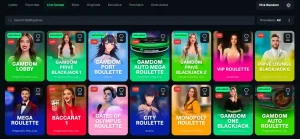
Gamdom verifies both table games and live-dealer casino games. They should not be treated as the same product. Digital table games run as software titles, while live casino content is built around streamed dealer tables and provider-specific interfaces. A player choosing between them is making a different decision about pace, presentation and interaction.
Evolution Gaming is one of the providers highlighted in Gamdom’s current casino material and is particularly relevant to the live category. The catalogue page also positions live games as a major top-level area rather than an obscure subcategory. That supports treating live casino as a meaningful part of Gamdom’s global product mix.
This page keeps live coverage intentionally concise because the deeper questions belong on the Gamdom live casino page. That dedicated guide can focus on live-dealer structure and browsing without duplicating the full slot and Originals analysis here.
Gamdom Originals are a separate in-house layer
Gamdom Originals are games developed in-house rather than supplied by the third-party studios that fill most casino lobbies. The current official Originals material lists Crash, Dice, Plinko, Mines, HiLo and Roulette, and also includes Keno and Pocket Dice in the wider collection. These titles are generally built around compact rules and fast rounds rather than the themes and feature stacks common in video slots.
The Originals section is most useful when treated as a distinct first-party game family rather than as another provider row. The verified examples show that Gamdom uses this area for compact formats such as Crash, Dice, Plinko, Mines, HiLo and Roulette. Those examples are enough to describe the shape of the range without inventing a complete permanent list.
The most useful editorial distinction is therefore ownership and mechanics. Originals are a first-party product family with a consistent design philosophy; slots and live games come from a broader provider ecosystem. A review that mixes those categories together loses one of the clearer structural differences in the Gamdom catalogue.
Featured providers and what their presence tells you
Gamdom’s current casino page names Evolution Gaming, Pragmatic Play, Hacksaw Gaming, Betsoft and OneTouch among its featured providers. The same page says the wider library includes more than 40 providers. That provider breadth matters because it reduces dependence on one studio and gives the lobby multiple content types rather than a single dominant catalogue.
Provider presence is also a better comparison metric than a raw game number when choosing between casinos. A 5,000-title library concentrated heavily in one category can feel narrower than a smaller library spread across strong slot, table and live suppliers. Gamdom’s verified provider list supports breadth across those categories, although the exact title mix still needs to be checked in the live lobby.
This guide does not assign quality scores to individual providers or claim that a named studio’s full portfolio is present. The evidence supports the relationship between Gamdom and the listed providers, not every possible title-level inference.
How to browse the library without getting lost
- Start with format. Decide whether you want slots, table games, live dealer content or Originals before comparing individual titles.
- Use provider filters. A known studio can be a faster route into a large catalogue than scrolling the general lobby.
- Separate in-house games. Originals such as Crash, Dice and Plinko use a different design model from conventional video slots.
- Treat lobby rankings as dynamic. Hot or top-game sections can change with player activity and merchandising.
- Recheck the live lobby for availability. A game mentioned in older editorial material can rotate out or be unavailable in a particular context.
The same principle applies on smaller screens. For mobile-specific navigation and the difference between browser access and app claims, use the Gamdom mobile guide rather than assuming the desktop lobby structure maps perfectly to every device.
Games, rewards and account economics should be evaluated separately
A large catalogue does not automatically mean every game contributes to rewards in the same way. Gamdom’s reward system is personalised and the operator identifies game characteristics such as RTP as factors in reward calculations. That makes it important not to choose a game solely because a broad rewards page exists.
The Gamdom rewards guide explains the current Instant, Weekly and Monthly Rewards structure and the time-limited boosted Instant Rewards mechanism. This games page does not repeat those promotion mechanics because the user intent is catalogue breadth and structure, not bonus optimisation.
Likewise, this page does not publish unsupported jackpot claims. Available public information does not establish a brand-wide jackpot catalogue, so there is no separate jackpot section claiming progressive inventory that has not been confirmed.
Australian legal context is a boundary, not a game feature
For Australian readers, product analysis and legal availability must remain separate. ACMA states that online casinos are banned interactive gambling services for providers to offer to people in Australia under the Interactive Gambling Act framework. That legal rule does not change the factual description of Gamdom’s global catalogue, but it prevents a review from presenting the existence of slots or live games as evidence that the service is legally available to Australian customers.
The dedicated Gamdom trust and licence analysis covers the operator, licensing and regulatory evidence. This page stays focused on what the global casino product contains. That separation is especially important for a brand with a large crypto-first library, because technical access, payment capability and legal permission are different questions.
Who the Gamdom catalogue is most relevant to
From a product-comparison perspective, Gamdom is most distinctive for combining a large third-party casino catalogue with a visible in-house Originals layer. Players who want variety can move between conventional slots, table games and live dealer content, while users interested in simple crypto-native mechanics have a separate group of Originals to browse.
The trade-off is that the catalogue is too large and dynamic for static title lists to stay useful for long. A review should therefore help with navigation and evidence quality rather than pretending to be a complete game directory. Provider filtering, category selection and live-lobby checks are the practical tools that matter.
For an overview of the full site rather than only the casino catalogue, return to the Gamdom Australia review.
Verdict on Gamdom’s games
Gamdom’s casino product has clear breadth. Slots, table games, live casino and in-house Originals are all verified, and the current casino material describes more than 40 providers. Featured names include Evolution Gaming, Pragmatic Play, Hacksaw Gaming, Betsoft and OneTouch, while the Originals range includes Crash, Dice, Plinko, Mines, HiLo and Roulette.
The weaker metric is the exact total count because Gamdom’s own pages have published different figures. Calling the catalogue “thousands of games” is therefore more robust than treating one headline number as permanent. For decision-making, the stronger evidence is the combination of categories, provider breadth and the presence of a distinct in-house game family.
The result is a catalogue that should be evaluated by structure rather than sheer count. Use the live lobby to confirm current title availability, the provider filters to narrow the list, and the dedicated live-casino page when dealer content is the main reason for comparing Gamdom with another platform.
Why provider filters matter more as the catalogue grows
A catalogue in the thousands creates a discovery problem: more choice is useful only if the lobby helps a player narrow it. Provider filtering is therefore part of the product, not just a cosmetic navigation feature. A user who already knows a studio can reduce the search space immediately, while a user comparing formats can start with slots, tables, live games or Originals before looking at individual titles.
This matters for review accuracy as well. Static lists of hundreds of game names age quickly, especially when regional availability or supplier rotations change. Provider and category evidence is more resilient because it describes how the catalogue is structured. The current Gamdom material supports more than 40 providers and clearly separated product families, which is a stronger long-term signal than one day’s featured row.
The best publication practice is to use the lobby as a live inventory check and the review as a navigation guide. That keeps the page useful even when individual games move, while still giving readers verified examples of the suppliers and Originals that define the catalogue.
What not to infer from a large game library
Library size does not prove that every game is available in every country, that every title has the same RTP, or that every provider is exposed to every account. It also does not establish a jackpot programme, a particular tournament schedule or a guarantee that one named title will remain in the lobby. Those are separate facts that need their own evidence.
For Australian readers, the same separation is essential between product inventory and legal access. A globally documented game category can be described as part of Gamdom’s product without turning that description into a claim that an Australian user is legally permitted to access it. Keeping those layers distinct makes the catalogue analysis more precise rather than less useful.